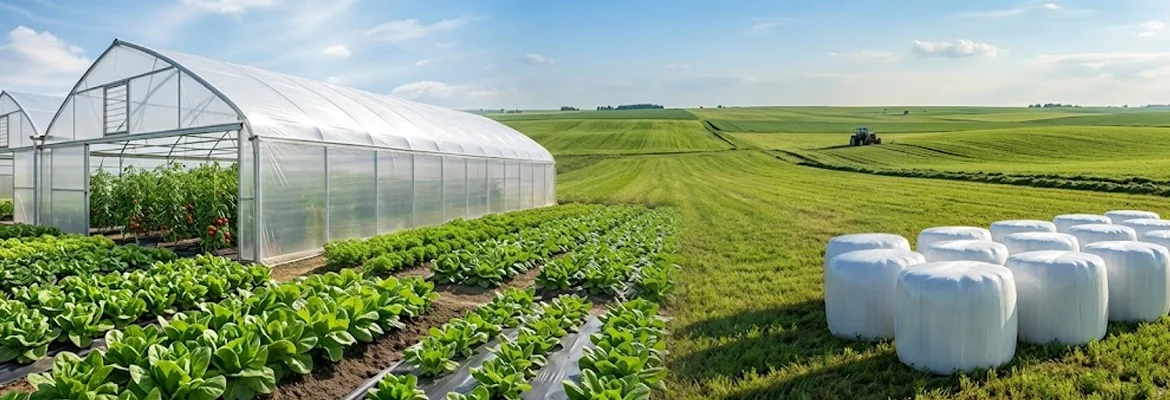
These agricultural films help growers manage greenhouse conditions and allow livestock farms to store nutritious forage throughout the year. Their performance can directly affect production costs, crop quality, and feed losses.
1. Greenhouse film and crop microclimates
Greenhouse film helps control light, temperature, and humidity around the crop canopy. Approximately 80% of newly constructed greenhouses in the United States use double-layer, air-inflated polyethylene covers.
Light transmission and PAR
Photosynthetically active radiation (PAR) provides the wavelengths plants use for photosynthesis. In greenhouse production, even small changes in available light can affect crop development and yield.
Traditional polyethylene films may collect dust and lose transparency as they age, reducing light transmission to approximately 85% to 88%. Advanced polyolefin (PO) greenhouse films can provide transmission levels of up to 95%, making them particularly useful during winter, when natural sunlight is limited.
Condensation control
Condensation on the inside of a greenhouse cover can form droplets that fall onto crops. Persistent moisture increases the risk of fungal diseases such as Botrytis cinerea, commonly known as gray mold, and powdery mildew.
Anti-drip additives used in standard PE films may remain effective for only three to six months. PO films with external nano-coatings can provide longer-lasting condensation control, with some products designed to perform for three to five years.
Reduced nighttime heat loss
Greenhouse films containing infrared additives help retain heat after sunset. In heated greenhouses, these films can reduce nighttime heat loss by approximately 10% to 20%. This can lower heating costs, especially for growers in colder northern states.
2. Silage stretch film and year-round feed storage
Livestock and dairy farms need a reliable supply of nutritious forage throughout the year. When fresh grass and corn are unavailable during winter, properly wrapped silage provides an important source of preserved feed.
Anaerobic fermentation
Good silage depends on maintaining an oxygen-free environment. Once the forage is wrapped and sealed, lactic acid bacteria can ferment the material and help preserve it.
If oxygen enters through loose wrapping, punctures, or damaged film, yeasts and molds can develop rapidly. This reduces dry matter and lowers the nutritional value of the feed.
High-oxygen-barrier technology
Conventional PE films have relatively high oxygen permeability. High-oxygen-barrier (HOB) films use an EVOH, or ethylene-vinyl alcohol, layer to restrict oxygen transmission.
Reported oxygen transmission rates are approximately for HOB film, compared with for conventional PE film. This represents a reduction of nearly 100 times.
Dry matter and nutrient preservation
Dry matter losses under standard PE covers can exceed 50% when mold growth is severe, while starch levels may fall close to zero. HOB silage films can keep dry matter losses within approximately 5% to 8% by limiting oxygen exposure.
Better sealing also helps preserve the forage’s energy, protein, starch, and carotene content. Controlling mold growth may additionally reduce the risk of mold-derived spores entering the milk supply.
Conclusion
Selecting the right agricultural film can have a measurable effect on farm efficiency and operating costs. High-transmission PO greenhouse films support crop growth while helping control condensation and heat loss. EVOH-based silage films limit oxygen exposure and protect stored forage from spoilage.
Although these materials may cost more initially than standard films, the difference can be offset through improved yields, lower energy use, and reduced feed losses.